
Why we built this
The advice available to prospective earth science students has a consistent problem. It is written by content teams working from press releases, it treats institutional prestige as a proxy for quality, and it presents a single median salary as though it described anyone's actual prospects.
Meanwhile the students making these decisions are committing four years and a substantial amount of money on the basis of it. We have all three watched people arrive in their first professional role having discovered too late that their program had no field component, or that their coursework did not satisfy a licensure board, or that the specialization they trained for employs a few thousand people nationally.
So the standard here is simple. We say where every number came from, we publish the ranking method so you can disagree with it specifically, and we tell you when the honest answer is that a path is small, cyclical, or not worth the money.
Meet the team

Steven Mitchell
Chief Geologist and Lead Editor
Steven has spent more than eighteen years as a field and structural geologist. He has led exploration teams for major mining and energy firms across the Rocky Mountains and the Appalachians, along with international project sites, and his published research covers sedimentary basins and tectonic evolution.
He is the reason this site does not publish a geology claim it cannot defend. Every technical statement about rock, structure, stratigraphy, or exploration practice goes through him before it is published, and he is unsentimental about cutting anything that sounds impressive but does not survive contact with fieldwork.
His view on program selection is blunt and consistent: a geology degree without serious field time is a science degree with a geology label on it. He argues that students should evaluate the field component of a program before they look at the ranking, the brochure, or the campus.
- Education
- Ph.D. in Geology, University of Texas at Austin · B.S. in Earth Sciences, University of California, Santa Barbara
- Credentials
- Professional Geologist (PG), licensed in multiple states · Certified Petroleum Geologist (CPG), AAPG
- Areas of expertise
- geological mapping, structural geology, mineral exploration, basin analysis, sedimentary geology
- Covers on this site
- Technical accuracy, geological data verification, and expert commentary across the site.
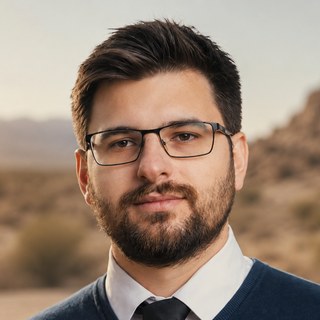
Miles Richards
Director of Geospatial and GIS Curriculum
Miles was GIS Director at a major environmental consulting firm before moving into education research. He led teams on large-scale mapping work including floodplain analysis, habitat restoration, and urban planning projects delivered for federal and state agencies.
He owns the largest section of this site, because geospatial programs are the largest part of the market. He built the classification system behind our program database, and he is the one who insists that a certificate, a concentration, and a full degree are three different things that should never be listed as if they were interchangeable.
His recurring argument to students: the software is the easy part. Employers can teach you a toolbar. They cannot teach you spatial reasoning, data quality judgment, and the ability to explain to a non-technical client why a map is wrong.
- Education
- M.S. in Geospatial Information Science, University of Maryland · B.S. in Geography, Pennsylvania State University
- Credentials
- GIS Professional (GISP) · Certified Geospatial Information Specialist
- Areas of expertise
- ArcGIS, QGIS, remote sensing, spatial data analysis, geospatial program design
- Covers on this site
- GIS and geospatial programs, geospatial careers, remote sensing, and spatial analytics.

Stacy Choi
Senior Resource and Environmental Geologist
Stacy has fifteen years in hydrogeology and environmental consulting, specializing in groundwater resource management, watershed analysis, contaminated site remediation, and environmental impact assessment. She has worked on both sides of the table, with state environmental agencies and with private engineering firms.
She covers the part of earth science where most of the actual jobs are. Federal data backs her up: environmental scientists and specialists hold roughly 90,300 jobs with about 8,500 openings a year, against roughly 25,100 jobs and 2,000 annual openings for geoscientists.
Her standing advice is about licensure. She believes the Professional Geologist license is the most underrated credential in the field, and she is direct about what it costs students to discover that too late, after they have taken a job that does not accrue qualifying experience.
- Education
- M.S. in Hydrogeology, Stanford University · B.S. in Environmental Geology, University of Michigan
- Credentials
- Professional Geologist (PG) · Certified Hydrogeologist (CHG)
- Areas of expertise
- groundwater resource management, watershed analysis, contaminated site remediation, environmental impact assessment
- Covers on this site
- Environmental geology careers, hydrogeology programs, sustainability pathways, and resource management.
Our editorial policy
We separate three categories of statement and we label them differently, because conflating them is how education content becomes untrustworthy.
| Category | How we handle it |
|---|---|
| Institutional facts | Program names, degree levels, departments, locations, and delivery formats come from our program database and link to the institution's own page, which remains the authoritative source. |
| Federal and issuer data | Wage, employment, and projection figures are cited to the Bureau of Labor Statistics with the specific occupation and reference date. Credential requirements are cited to the issuing body. |
| Editorial opinion | Our judgments appear in clearly marked position boxes and are attributed to the team member responsible for that subject area. They are opinion, informed by data and experience, and we say so. |
What we will not do
- We do not sell ranking positions, and no institution can pay to appear or to improve a score.
- We do not publish statistics we cannot source. If a number appears on this site, we can tell you where it came from.
- We do not present a national median salary as though it were an entry-level offer.
- We do not rank on reputation surveys, because asking academics to rate other academics measures name recognition.
- We do not claim a program guarantees employment, because no program does.
Our research base
The program database behind this site currently covers 1,340 degree and certificate programs at 491 institutions across 50 states, spanning geology and earth science, GIS and geospatial technology, environmental science, surveying and geomatics, remote sensing, and planning. Each record carries the institution, department, location, credential level, documented delivery format, and a direct link to the official program page.
It is not exhaustive, and we say so on every ranking page. Program inventories change constantly as departments add, rename, and retire offerings, and we would rather tell you the coverage is partial than imply a completeness we cannot maintain.
Corrections
If something here is wrong, we want to know. Program details change, institutions restructure departments, and federal data is revised on its own schedule. Corrections to substantive claims are made on the page itself, and pages carry a review date so you can judge how current the information is. This page was last reviewed August 14, 2026.
Frequently asked questions
Who funds GeologyPrograms.com?
The site is independently operated. We are not paid by institutions to appear in rankings, and no school can purchase a position or an improved score. Where we earn revenue, it does not influence editorial judgment or ranking placement.
How do you decide what to rank?
Every ranking is generated from our program database using the Program Quality Index, a seven-factor score computed from attributes institutions publish about their own programs. The full method, including its limitations, is published on our methodology page.
Do you correct mistakes?
Yes. If a program listing is wrong or out of date, or a data citation is inaccurate, tell us and we will correct it. Corrections to substantive claims are made to the page directly rather than quietly removed.